Showing posts with label Technology. Show all posts

Vijay P. Bhatkar. [ Architecture of India's IT industry ]

 Vijay P. Bhatkar 

[ Architecture of India's IT industry ]


Vijay P Bhatkar


Vijay Bhatkar  [ Born 11 October 1946 ] is an Indian scientist. India's computer magazine Dataquest has placed him among the star pioneers who shaped India's IT industry.


Career & Contributions

Bhatkar is best known as the architect of India's national initiative in supercomputing where he led the development of Param supercomputers. He developed the first Indian supercomputer, the Param 8000, in 1991 and then later the Param 10000 in 1998. Based on the Param series of supercomputers, he built the National Param Supercomputing Facility (NPSF) which has been now made available as a grid computing facility through Garuda grid on the National Knowledge Network (NKN) providing nationwide access to High Performance Computing (HPC) infrastructure. Currently, Bhatkar is working on exascale supercomputing via the Capability, Capacity and Infrastructure on National Knowledge Network.

Bhatkar has authored/edited over 12 books and 80 technical and research papers and addressed several university convocations, international and national conferences and conventions and public functions.

Awards & Recognitions


Bhaktar received the Padmashri Award in 2000 from the Government of India and the Maharashtra Bhushan Award of 1999-2000, the highest recognition of the Government of Maharashtra.[citation needed] He was the recipient of the Jindal Prize in 2012 for science and technology in the service of society.[citation needed] He received with the Saint Jnaneshwar World Peace Prize in 2010 from the World Peace Center for promoting synthesis of science and spirituality in the service of humanity.[citation needed] He was awarded Sitaram Jindal Foundation Award-2012 for applying the science and technology to grassroot level.

Vijay Bhatkar is the Chairman of Board of Governors of IIT-Delhi, Chairman of ETH Research Lab, Founder Chancellor and Chief Mentor of Multiversity, Chancellor of D. Y. Patil University, and National President of Vijnana Bharati, a People's Science Movement of over 6,000 scientists across India.

MADE IN INDIA - Supercomputer's.

PARAM 8000 is considered India's first supercomputer. It was indigenously built in 1990 by Centre for Development of Advanced Computing and was replicated and installed at ICAD Moscow in 1991 under Russian collaboration.

Supercomputers in India.

Prithvi

Indian Institute of Tropical Meteorology, Pune, has a machine with a theoretical peak of 790.7 teraflop/s, called Prithvi, which is being used for climate research and operational forecasting. It is ranked 36th among the world's top 500 supercomputers June 2013 list.

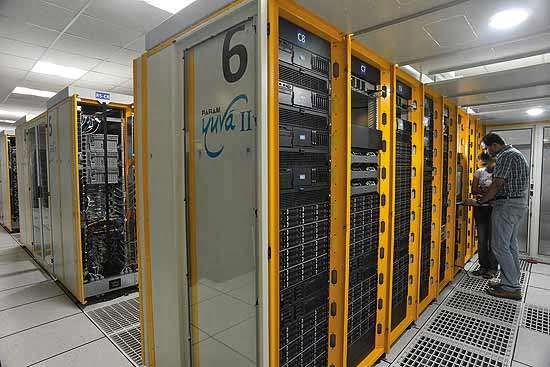
PARAM Yuva II

PARAM Yuva II


Unveiled on 8 February 2013, this supercomputer was made by Centre for Development of Advanced Computing in a period of three months, at a cost of INR160 million [ US$3 million ]. It performs at a peak of 524 teraflop/s, about 10 times faster than the present facility, and will consume 35% less energy as compared to the existing facility. According to CDAC, the supercomputer can deliver sustained performance of 360.8 teraflop/s on the community standard Linpack benchmark, and would have been ranked 62 in the November 2012 ranking list of Top500. In terms of power efficiency, it would have been ranked 33rd in the November 2012 List of Top Green 500 supercomputers of the world. It is the first Indian supercomputer achieving more than 500 teraflops. 
Param Yuva II will be used for research in space, bioinformatics, weather forecasting, seismic data analysis, aeronautical engineering, scientific data processing and pharmaceutical development. Educational institutes like the Indian Institutes of Technology and National Institutes of Technology can be linked to the computer through the national knowledge network. This computer is a stepping stone towards building the future petaflop-range supercomputers in India.


SAGA-220

SAGA - 220

SAGA-220 built by ISRO, is capable of performing at 220,000 gigaflop/s [ 220 teraflop/s ]. It uses about 400 NVIDIA Tesla 2070 GPUs and 400 Intel Quad Core Xeon CPUs.


EKA

EKA

EKA is a supercomputer built by the Computational Research Laboratories with technical assistance and hardware provided by Hewlett-Packard.This is developed by Tata sons. It is capable of performing at 132800 gigaflop/s or 132 teraflop/s. 


Virgo

Vigro Supercomputer
Indian Institute of Technology, Madras has a 91.1 teraflop/s machine called Virgo. It is ranked as 364 in the Top 500 November-2012 list. It has 292 computer nodes, 2 master nodes, 4 storage nodes and has total computing power 97 TFlops. According to Linpack Performance, Virgo is the fastest cluster in an academic institution in India. In terms of performance, it has an Expand [ Rmax ] of 91.126 TF and Expand [ RPeak ] of 97.843 TF. The computing efficiency is 932 Expand [ MFlop/Watt ]. As of 2012, Virgo is at 224th position in the world [ Top500 ], 5th ranked energy efficient machine in the world and 1st ranked energy efficient machine in India.


PARAM Yuva


PARAM Yuva

PARAM Yuva belongs to the PARAM series of supercomputer developed by the Centre for Development of Advanced Computing. It is capable of performing at about 54000 gigaflop/s or 54 teraflop/s.
 

Future supercomputers of india

The Indian Government has proposed to commit 2.5 billion USD to supercomputing research during the 12th five-year plan period  [ 2012-2017 ]. The project will be handled by Indian Institute of Science [ IISc ], Bangalore. Additionally, it was later revealed that India plans to develop a supercomputer with processing power in the exaflop range. It will be developed by C-DAC within the subsequent 5 years of approval.
According to the approved plan of the Indian Government, a supercomputer grid will be set up across India’s top educational and research institutions, consisting of more than 70 supercomputers. Of the 70 planned machines, around 20 will be in the range of 10 petaflops, several others will be in the 100-500 teraflops range while the rest will be smaller.